Oh, good. I usually forget these things anyway so I am excited that people are focusing on creating a more lasting impression. BMW has been working on an ad campaign that burns a BMW logo into your eyes, so to speak, so that when you close them, instead of the fuzzy blackness, you get a beamer reminder. Oh, good.
http://theweek.com/article/index/210537/bmw-burning-its-logo-into-your-brain
Monday, October 29, 2012

Sunday, October 21, 2012
Vibrations
I've been doing some thinking. And I think that certain messages, if delivered with certain sounds, intrinsically are easier to remember. Wait, that's not quite it. The messages automatically become logged and I find I have an immensely high recall of technical facts years later if I hear those sounds. This is one of them. Tibetan meditation (low range) bowls are another.
I would probably be interested in making a hang drum someday because they are so supa sweet.
I would probably be interested in making a hang drum someday because they are so supa sweet.
Athene's Theory of Everything.
Uh. Ya, had to watch it twice. Still didn't get all of it. Kind of a funny presentation but the messages- obvious, subtle and distilled, are brilliant.
Thursday, October 18, 2012
Amber is the Color of your energy
Ah, forgot to add this bit. Good on you Wikipedia!
The English word amber derives from the Arabic anbar, via Medieval Latin ambar and Old French ambre.
Amber is discussed by Theophrastus, possibly the first historical mention of the material, in the 4th century BC. The Greek name for amber was ἤλεκτρον (elektron), "formed by the sun", and it was connected to the sun god (Helios), one of whose titles was Elector or the Awakener. According to the myth, when Helios' son Phaëton was killed, his mourning sisters became poplars, and their tears became the origin of elektron, amber.
Another early reference to Amber was Pytheas (330 BC) whose work "On the Ocean" is lost, but was referenced by Pliny. According to The Natural History" by Pliny the Elder:
While amber is not actually named, it is called the concreti maris purgamentum, "the leavings of the frozen sea" after the spring melt. Diodorus uses ēlektron, the Greek word for amber, the object that gave its name to electricity through its ability to acquire a charge. Pliny is presenting an archaic view, as in his time amber was a precious stone brought from the Baltic at great expense, but the Germans, he says, use it for firewood, according to Pytheas.
Heating amber will soften it and eventually it will burn, which is why in some Germanic languages the word for amber is a literal translation of burn-stone. Heated above 200 °C, amber suffers decomposition, yielding an "oil of amber", and leaving a black residue which is known as "amber colophony", or "amber pitch"; when dissolved in oil of turpentine or in linseed oil this forms "amber varnish" or "amber lac".
Amber from the Baltic Sea has been extensively traded along the Amber Road since antiquity; and in the mainland, from where amber was traded 2000 years ago, the natives called it glaes (referring to its see-through quality similar to glass).
In ancient times, well-established trade routes for amber originated from the Baltic countries (where amber was plentiful along the coast) that went to virtually every corner of Europe. Early in the nineteenth century, the first reports of amber from North America came from discoveries in New Jersey along Crosswicks Creek near Trenton, at Camden, and near Woodbury.
The English word amber derives from the Arabic anbar, via Medieval Latin ambar and Old French ambre.
Amber is discussed by Theophrastus, possibly the first historical mention of the material, in the 4th century BC. The Greek name for amber was ἤλεκτρον (elektron), "formed by the sun", and it was connected to the sun god (Helios), one of whose titles was Elector or the Awakener. According to the myth, when Helios' son Phaëton was killed, his mourning sisters became poplars, and their tears became the origin of elektron, amber.
Another early reference to Amber was Pytheas (330 BC) whose work "On the Ocean" is lost, but was referenced by Pliny. According to The Natural History" by Pliny the Elder:
While amber is not actually named, it is called the concreti maris purgamentum, "the leavings of the frozen sea" after the spring melt. Diodorus uses ēlektron, the Greek word for amber, the object that gave its name to electricity through its ability to acquire a charge. Pliny is presenting an archaic view, as in his time amber was a precious stone brought from the Baltic at great expense, but the Germans, he says, use it for firewood, according to Pytheas.
Heating amber will soften it and eventually it will burn, which is why in some Germanic languages the word for amber is a literal translation of burn-stone. Heated above 200 °C, amber suffers decomposition, yielding an "oil of amber", and leaving a black residue which is known as "amber colophony", or "amber pitch"; when dissolved in oil of turpentine or in linseed oil this forms "amber varnish" or "amber lac".
Amber from the Baltic Sea has been extensively traded along the Amber Road since antiquity; and in the mainland, from where amber was traded 2000 years ago, the natives called it glaes (referring to its see-through quality similar to glass).
In ancient times, well-established trade routes for amber originated from the Baltic countries (where amber was plentiful along the coast) that went to virtually every corner of Europe. Early in the nineteenth century, the first reports of amber from North America came from discoveries in New Jersey along Crosswicks Creek near Trenton, at Camden, and near Woodbury.
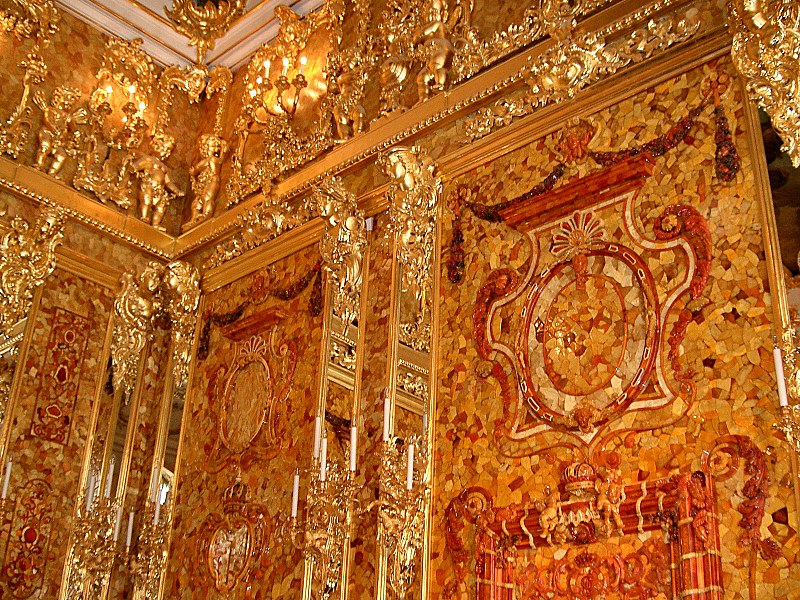
Янтарная комната Yantarnaya komnata
Or otherwise known as the Amber Room. This is very fascinating to me. It is a room built in the 17th century, taking a decade to complete (+/-), made entirely of amber and gold. Yowza. Huge panels of amber inlay were the walls, the floor, over 6 tons of amber. This is incredible. Amber is a very interesting stone because it its actually a resin from the sap of ancient trees. Therefore, not really a stone but a fossil, if you will. (see on amber below). It was built in Russia and that makes sense they needed a sunny sun room to brighten up their serious faces. But lo! Here comes ze Germans.... during WWII the Germans looted this room and tried to relocate it back to headquarters. In the meantime, the castle they were storing it in got blown up. No more amber room. It was called the 8th wonder of the world. But good on the Russians- they rebuilt it in 2003. So its there, but its not from the 17th century. This is truly the stuff of legend.
Subscribe to:
Comments (Atom)